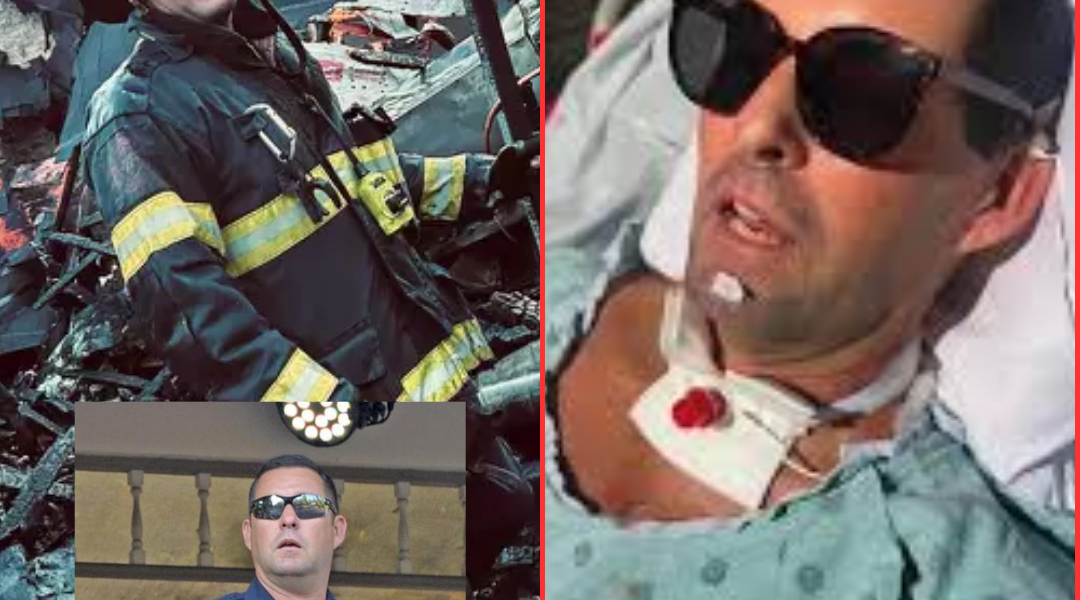
Wentzville Fire Captain Tommy Shine Dies After Medical Emergency — Then His Fellow Firefighters Revealed the Final Moment That Left the Whole Station Silent

Wentzville Fire Captain Tommy Shine Dies After Medical Emergency — Then His Fellow Firefighters Revealed the Final Moment That Left the Whole Station Silent
The firehouse did not go quiet because the alarm stopped ringing.
It went quiet because Captain Tommy Shine was gone.
For a long time afterward, the building still sounded like a firehouse. Radios cracked. Boots crossed the bay floor. Doors opened and closed. The coffee maker coughed through another pot before sunrise, and somewhere in the apparatus room, a compressor kicked on with the same blunt mechanical breath it had always had.
But everyone inside could feel the difference. There are silences that arrive when people stop talking, and there are silences that arrive when something essential has been taken from a place. This was the second kind.
In Wentzville, Missouri, people knew the fire station by its sirens, its red trucks, and the steady confidence of the men and women who stepped out when everyone else stepped back. But inside that world, Captain Tommy Shine had never been just another name stitched across a uniform. He was a presence.
He was the man who noticed when a young firefighter was pretending not to be nervous. He was the officer who could walk into a room heavy with stress and somehow lower the temperature without saying much. He had a way of standing in the bay, one hand resting near his radio, eyes moving over everything, that made people feel the situation had already become more manageable.
That was why, after the medical emergency, the first hour felt impossible to understand.
Men who had seen wreckage, fire, smoke, river water, winter roads, and the worst kind of late-night calls stood in place like they were waiting for instructions that would not come. They were trained for chaos. They were trained to move when the body wants to freeze. They were trained to answer tones at two in the morning and walk into rooms where strangers were having the worst day of their lives.
But no training teaches a station how to lose one of its own.
The news moved through the department quietly at first, not because anyone wanted to hide it, but because saying it out loud made it real. Someone stood near the duty board and stared at his name. Someone else walked past his locker, stopped, and then kept walking because looking at it for too long felt like trespassing on grief.
By midmorning, the condolences had begun.
They came from nearby departments, from people in uniform, from families who had once met him at scenes they would never forget, from citizens who knew only fragments of what he had done but understood enough to mourn. Firefighters from towns around Wentzville sent messages that were short because nobody in that profession wastes words when the feeling is already understood.
“Brother, we have it from here.”
“Rest easy, Captain.”
“Thank you for everything.”
Those messages kept arriving, one after another, and each one seemed to press the station deeper into the same stunned quiet.
To outsiders, the story could have been summarized in a few lines. A respected fire captain. A medical emergency. A community in mourning. A record of service. A department grieving a loss.
But inside the station, no one was thinking in summaries.
They were thinking about the last time he had laughed near the kitchen table. They were thinking about the way he corrected a younger firefighter without embarrassing him. They were thinking about the winter call that had become part of Wentzville’s memory, the frozen lake rescue people still spoke about as if courage itself had stepped onto the ice that day.
They were thinking about how close he himself had come to death once before, and how he had fought his way back with a patience that looked almost impossible to those who witnessed it.
And they were thinking about the final moment.
Not the public moment. Not the kind that appears in a headline. Not the kind that strangers would immediately understand.
It was smaller than that.
It was quieter.
It was the kind of detail that could have been missed by anyone who did not know how firehouses remember their own.
Before they revealed it, the men and women at the station carried it privately, as if it were too sacred to place too quickly into words. They moved around it for hours. They answered phones. They spoke to family. They accepted hugs from people who came by because they did not know what else to do. They stood in the apparatus bay and nodded when someone said, “He was a good man,” because there was no better sentence and yet the sentence was nowhere near enough.
Outside, Wentzville continued moving.
Cars passed through intersections. Parents picked children up from school. People stopped for groceries and gas and prescriptions. The ordinary life of an American town went on with its bright signs, its traffic lights, its neighborhoods, its weekend plans, and its small frustrations.
That is one of the hardest things about grief inside a fire department. The world keeps requiring service while the people who serve are trying to understand that one of their own will not walk through the door again.
The station had answered calls with Tommy Shine in the officer’s seat. It had watched him check equipment with a practiced eye. It had heard his voice come across the radio, controlled and clear even when a scene was anything but controlled. It had known him as a captain, a colleague, a mentor, and a friend.
Now the same station had to learn the shape of his absence.
A firefighter’s absence is different from other absences because the job is built on response. Every object inside the station has a purpose. Every jacket, helmet, glove, tool, map, hose bed, and medical bag exists because at any second, someone may need them. The place is designed for motion.
So when grief enters that kind of building, it has nowhere comfortable to sit.
It gathers near the lockers.
It waits beside the empty chair at the kitchen table.
It hangs in the pause after the tones drop, when everyone moves out of instinct and then remembers the one voice they will not hear.
Tommy had understood that life. He understood the rhythm of the firehouse, the jokes that covered exhaustion, the quiet meals interrupted by alarms, the strange intimacy of people who know what one another looks like under pressure. He understood how firefighters become family without announcing it, simply by showing up for the same hard things again and again.
Years earlier, the frozen lake call had shown the community a version of him that his fellow firefighters already knew.
It had been the kind of cold that makes breath feel sharp. The kind of Missouri winter day when water does not look like water anymore, when ice lies across a lake like a promise that cannot be trusted. A teenager was in danger, and in those moments, every second carried weight.
People later talked about the rescue with awe, but firefighters rarely describe themselves as brave in the way civilians expect. They talk about procedure, timing, training, teamwork. They talk about what needed to be done. They say things like, “That was the job,” because naming courage too directly can feel uncomfortable when you have seen how much luck and teamwork are involved.
But everyone who knew the story understood what it meant.
Someone had been in trouble.
Tommy had moved toward the danger.
That was the pattern of his life.
It was not only dramatic rescues that defined him. In the fire service, reputation is built in smaller increments. It is built during equipment checks, training nights, long calls, family open houses, and the quiet debriefs after scenes no one wants to remember. It is built in how a captain treats the newest person in the room when no chief is watching. It is built in whether people trust your judgment when the smoke is low and the clock is unforgiving.
By that measure, Tommy’s reputation had been earned one day at a time.
You could hear it in the way younger firefighters spoke about him. They did not describe him as perfect, because firehouses do not trust perfect men. They described him as steady. Fair. Tough when he needed to be. Kind in ways that did not demand credit. The kind of officer who made you want to be better because he assumed you could be.
One young firefighter remembered his first bad call with Tommy.
He had been new enough that his gear still looked too clean and his confidence still needed reminding. The call had not been large by newspaper standards, but it had been ugly in the private way emergencies often are. Afterward, while the rest of the crew reset equipment, the young man stood too long near the rear of the engine, trying to look busy so nobody would notice his hands were shaking.
Tommy noticed.
He did not make a speech. He did not embarrass him. He walked over, checked a compartment latch that did not need checking, and said quietly, “You did your job. Now breathe before the next one.”
Then he stood there for a few seconds longer, giving the young firefighter permission to collect himself without saying that was what he was doing.
Years later, that firefighter would remember the sentence not because it was dramatic, but because it arrived exactly when he needed it.
That was the kind of man grief had taken from the station.
After the medical emergency, people kept repeating the same question in different forms, even when they knew there was no answer that could satisfy them.
How could someone like that be gone so suddenly?
How could a man who had survived danger, who had fought through his own near-death battle, who had come back from pain with a stubbornness that inspired everyone around him, be taken in a way that left no room for one more conversation?
How could the station continue as if the whole building had not shifted?
The answer, of course, was that it could not continue as if nothing had changed. It could only continue because that was what firefighters do. They grieve, and then the tones drop. They stand at a funeral, and then they return to the bay. They lower flags, cover badges, make calls to families, wipe down trucks, and answer strangers who need help before their own sorrow has found a place to settle.
But before the department could move forward, it had to remember.
By the afternoon, more people had gathered at the station. Some arrived in uniform, some in plain clothes. Some brought food because that is what communities do when words fail. A casserole dish appeared on the counter. A box of coffee cups sat near the sink. Someone left flowers near the entrance, and for a while nobody moved them.
The station became both workplace and memorial.
Every corner seemed to produce a story.
Someone remembered Tommy teasing a firefighter about backing the engine too slowly, then spending twenty minutes afterward explaining the exact angle that made the bay door easier. Someone remembered him showing up early before a public event because he wanted the kids visiting the station to see everything polished and ready. Someone remembered his laugh when a rookie mistook one tool for another and then tried to talk his way out of it.
There were stories of rescues, but there were also stories of ordinary decency.
A neighbor who had once called after a small kitchen fire remembered how Tommy had stayed a few extra minutes after the danger was over, explaining what had happened in plain language so her children would not be afraid to sleep in the house again.
A parent remembered him kneeling to speak to a child during a school visit, answering a question about smoke alarms with the seriousness adults usually reserve for other adults.
A retired firefighter remembered him from a training day years earlier, standing in heat and sweat, refusing to let frustration turn into cruelty when a drill went wrong.
“Tommy never needed to make you feel small to teach you something,” the retired firefighter said.
That sentence traveled through the room because it sounded exactly right.
There are people whose authority depends on volume. Tommy’s did not. His authority came from competence, from consistency, and from the quiet understanding that leadership is not the same as control. A captain’s job is not only to give orders. It is to know the people taking those orders well enough to protect them from their own fear, pride, exhaustion, and doubt.
Tommy had done that.
Maybe that was why the final moment mattered so much.
Because it was not about death.
It was about what his life had taught the people around him to do after death arrived.
As evening approached, the station’s light changed. Sun fell low across the bay doors. The polished curves of the trucks caught orange reflections from outside. The air smelled faintly of coffee, rubber, metal, and something warm someone had brought in foil. Voices softened as the day wore everyone down.
The chief stood near the front of the room with the expression of a man carrying official responsibility on top of personal loss. He had already spoken to family. He had already handled calls that no one should have to handle. Now he looked around at the firefighters gathered there, at the faces turned toward him, and for a moment he seemed unable to begin.
No one rushed him.
Finally, he spoke about service.
He spoke about sacrifice.
He spoke about the way Tommy had represented the department not only in emergencies but in daily conduct, in patience, in humility, in the unglamorous work that keeps a firehouse ready.
He spoke about the frozen lake rescue because he had to. He spoke about Tommy’s own battle because everyone in the room knew what it had cost him. He spoke about courage, but carefully, as firefighters do, without polishing it into something too clean.
Then his voice changed.
He said there was something the crew wanted the family to know, something the station needed to remember.
The room became still.
Not quiet. Still.
There is a difference. Quiet is the absence of sound. Stillness is when every person in a room begins listening with the same heartbeat.
The chief looked toward the apparatus bay, toward the place where Tommy had spent so many ordinary extraordinary hours, and he told them about the last small thing his fellow firefighters had noticed.
In the hours before everything changed, Tommy had done what he always did.
He had checked on his people.
Not dramatically. Not because he knew it would be remembered. Not because anyone had asked him to perform some final act of leadership. He had simply moved through the station in that familiar way, asking one firefighter about a family concern he had remembered from a week before, reminding another to finish a piece of training documentation, pausing near the kitchen long enough to make a dry comment that made two tired people laugh.
Then, before stepping away, he had done something so ordinary that no one understood its weight until later.
He had looked back into the bay.
He had rested his hand briefly against the side of the engine.
And he had said, almost under his breath, “Take care of each other.”
At the time, no one treated it like a farewell.
Why would they?
Firefighters say things like that. Captains say things like that. In a profession where trust is not decorative but necessary, reminders to take care of each other are woven into the language of the job. It might have been about the next call. It might have been about fatigue. It might have been about nothing more than the practical wisdom of a man who knew how quickly a normal day could turn.
But after the medical emergency, after the calls, after the news became real, the sentence returned.
Take care of each other.
It came back first to one firefighter, then another. Someone said, “He said that this morning.” Someone else looked up, startled, because he had heard it too. Then a third person remembered the hand on the engine, the pause, the glance across the bay.
The detail spread through the station slowly, not like gossip but like a candle being passed from hand to hand.
Take care of each other.
By the time the chief repeated it aloud, the room had already begun to understand why it hurt so much.
Those were not grand last words. They were better than grand. They were useful. They were Tommy. They carried no demand for attention, no attempt to make himself larger than the moment. They were the kind of words a captain leaves behind when he has spent his life thinking first about the crew.
For several seconds after the chief said them, nobody moved.
A firefighter near the back lowered his head.
Another pressed his thumb and forefinger against his eyes.
Someone’s radio clicked softly, then settled.
The whole station seemed to hold its breath.
That was the final moment his fellow firefighters revealed, and that was the moment that left the station silent.
Not because it answered their grief.
Because it gave their grief a direction.
Take care of each other.
In the days that followed, the phrase became more than a memory. It became instruction. People repeated it when they were not sure what else to say. They wrote it in messages. They carried it into the bay before calls. They heard it in the pause before sleep and in the heavy quiet after returning from scenes that already felt different without him.
At first, the words made the loss sharper. Every repetition was a reminder that the man who had said them was gone. But slowly, as grief does when allowed to breathe, the words began to hold something else too.
They held continuity.
A captain can leave behind awards, photographs, newspaper clippings, rescue stories, commendations, and a uniform pressed for ceremony. Those things matter. They tell the public what kind of service was given. They preserve history.
But inside a firehouse, the deepest legacy is behavioral.
It is what people do differently because you were there.
A rookie checks on another rookie because Tommy once checked on him.
A tired officer chooses patience because Tommy showed that authority did not require humiliation.
A firefighter stays a little longer after a call to explain something to a frightened family because Tommy once did the same.
A crew returns from a hard night and someone says, “Eat something before you sit down,” because care in the fire service is often practical before it is poetic.
That is how a person remains.
Not as a statue.
As a standard.
The memorial arrangements brought the community closer to the department in ways that were both comforting and painful. Flags lowered. Black bands appeared across badges. Departments from surrounding areas offered support so Wentzville crews could attend services, stand together, and grieve without worrying that the city would be left unprotected.
That is another thing civilians often do not see. When one department loses someone, other departments step in. They cover stations. They answer calls. They drive apparatus through unfamiliar streets so grieving crews can stand beside a family and honor the dead.
The fire service is local, but its brotherhood is wide.
On the day people gathered to honor Tommy Shine, the sight of uniforms seemed to stretch beyond one town. Firefighters came not because they had all known him personally, but because they knew what the loss meant. They knew the weight of a helmet placed with care, the sound of bagpipes, the discipline required to stand straight when your throat tightens, the particular ache of hearing a final call.
A final call is not just ceremony.
It is the profession speaking to itself in the only language large enough for that moment. It says that the work is complete. It says that the member is no longer answering alarms. It says that the rest must continue.
For those who loved Tommy, every formal gesture carried private memories underneath it.
When his name was spoken, some remembered the rescue.
Some remembered the hospital days from his own battle, the uncertainty, the stubborn return, the way he had refused to let hardship become the only story people told about him.
Some remembered jokes.
Some remembered advice.
Some remembered arguments that no longer mattered.
Some remembered the morning he said, “Take care of each other,” and then had to look away because the sentence had become almost too much to bear.
The public saw honor.
The station felt amputation.
After the services, after the visitors went home, after the last formal words were spoken, the firefighters returned to the place where grief had first gathered. The station looked the same and not the same. That is how beloved places behave after loss. They refuse to change enough to match what happened.
The engine still waited.
The gear still hung.
The kitchen still needed cleaning.
The duty board still needed updating.
Someone still had to check fuel levels, test equipment, review reports, train, eat, sleep lightly, wake fast, and go when the tones dropped.
For a while, every routine felt like an insult.
Then, gradually, routine became mercy.
The first call after a loss is always strange. Nobody says so loudly, but everyone knows it. The tones drop, and grief has to move its feet. Boots hit the floor. Jackets come off hooks. The engine starts. Doors rise. The crew rolls out into a town that may not know it is being protected by people carrying fresh sorrow in the cab.
That first call was not the frozen lake. It was not the kind of scene that becomes famous. It was ordinary by firehouse standards, which means it was still someone’s emergency. A medical call. A worried family. A living room too small for fear. A patient who needed calm more than drama.
The crew did what they were trained to do.
They assessed. They spoke clearly. They made space. They treated the patient. They reassured the family. They carried competence into a frightened room.
And afterward, back at the station, one of them stood by the engine and said quietly, “He would’ve liked how that went.”
No one answered right away.
Then someone said, “Yeah.”
It was not healing. Not yet.
But it was a start.
Stories continued to surface in the weeks that followed. Grief has its own archive, and it opens slowly. People remembered things they had not thought about in years. They told each other stories over coffee, during cleanup, in parking lots, after training, before sleep.
One firefighter remembered Tommy’s advice about fear.
Fear, Tommy had told him, was not the enemy. Panic was. Fear meant your body understood that something mattered. The job was to keep fear from driving. Let it sit in the passenger seat if it had to, but never hand it the wheel.
Another remembered him talking about family.
The fire service could take more than people realized, he had said. Missed dinners. Interrupted birthdays. Holidays cut short. Nights when the body came home but the mind stayed with the call. You had to protect your home life with the same seriousness you protected a fire scene, because if you lost the people waiting for you, the job could not replace them.
Another remembered him after his own health battle, moving slower than before but looking at the station like a man grateful for one more day inside it.
He had not returned unchanged. No one survives a near-death experience unchanged. But he returned with a deeper patience, a kind of perspective that made small complaints smaller and important things clearer.
He knew what it meant to be vulnerable.
That may have made him stronger.
There is a kind of strength that comes from never being tested, and it is brittle. Then there is the strength that comes from being broken open and still deciding to serve. Tommy’s fellow firefighters had seen the second kind in him. They had watched him endure, recover, adapt, and keep giving what he could.
That made his sudden loss even harder.
It also made his final instruction more powerful.
Take care of each other.
The words did not erase the pain, but they gave the crew something to do with their hands.
They checked in more often. Not perfectly. Firefighters are still human, still stubborn, still prone to answering “I’m good” when they are not good at all. But the sentence lingered. It made avoidance harder. It made silence less absolute. It gave people permission to ask twice.
“You good?”
“Yeah.”
“No. Really.”
Sometimes that was enough to open a door.
Sometimes it was not.
But they kept trying.
In Wentzville, the community’s grief also changed shape. At first, people responded to the news. Then they responded to the life. They learned more about the captain behind the title, the man behind the uniform, the neighbor, the mentor, the rescuer, the survivor. His story became not only an announcement of death, but a reminder of what public service costs and what it can mean.
Children who had once met him at station events asked parents why firefighters were sad. Parents tried to explain that heroes are not only people in movies. Sometimes they are people who check smoke detectors, carry medical bags, crawl through smoke, teach safety lessons, and remember your name. Sometimes they live in your town and shop at your stores and wave from engines in parades.
Sometimes they are gone before anyone is ready.
For the firefighters, public appreciation helped, but it did not simplify anything. Compliments can honor grief without removing it. A town can say thank you, and the station can still ache. Both things can be true.
What mattered most was that people remembered him accurately.
Not as a flawless symbol.
As a man.
A man who served. A man who laughed. A man who could be direct. A man who carried responsibility. A man who knew danger and still answered calls. A man who survived one battle and was lost after another arrived without warning. A man whose last remembered instruction was not about himself, but about the people beside him.
That was why the story stayed with those who heard it.
It did not depend on spectacle.
It depended on recognition.
Everyone who has ever loved a steady person understands the terror of losing them. Everyone who has ever worked beside someone trustworthy knows how deeply their absence can alter a room. Everyone who has ever heard ordinary words become sacred after the speaker is gone knows why a sentence can break people days later.
Take care of each other.
The line was simple enough for anyone to understand, but inside the firehouse, it carried layers.
Take care of each other on calls.
Take care of each other after calls.
Take care of each other when pride gets loud.
Take care of each other when grief gets quiet.
Take care of each other when the public sees the uniform but not the weight beneath it.
Take care of each other because the job is too heavy for one person to carry alone.
Take care of each other because tomorrow is not promised, even to the brave.
As time moved forward, the station found ways to keep him present without trapping itself in loss. His name was spoken during training. His lessons were repeated to new members who had not known him long enough. His stories became part of the department’s internal map.
That is how firehouses pass down more than procedure.
They pass down character.
A new firefighter might learn how to force a door from an instructor, how to advance a line from a drill, how to read smoke from experience. But he learns what kind of firefighter to become from the stories older members tell when they are cleaning tools or waiting for the next alarm.
“Captain Shine used to say…”
“Tommy would’ve checked that twice.”
“He had a way of handling this.”
“Remember what he told us.”
In those sentences, legacy becomes operational.
Not sentimental.
Operational.
It shapes decisions. It changes behavior. It steadies hands.
Months from now, someone will be tired after a long shift and tempted to rush a check. He may hear Tommy’s standard in the back of his mind and slow down. Someone will be frustrated with a recruit and tempted to snap. She may remember that teaching without humiliation was possible. Someone will return from a hard medical call and try to disappear into the familiar lie of being fine. Another firefighter may stop him near the bay and ask, “You good?” twice.
That is not the end of grief.
It is grief becoming useful.
The station will never again be exactly what it was when Tommy Shine walked through it. That is the truth no memorial phrase can soften. Loss does not return what it takes. It only teaches the living how to carry what remains.
But the firehouse did not stay silent forever.
It could not.
The tones dropped again.
The doors rose again.
The engines rolled again into Wentzville streets where people still needed help. And each time they did, the crew carried something with them that had not been listed on any equipment inventory.
They carried his example.
They carried the memory of a captain who moved toward danger, who survived hardship, who led without needing to dominate, who noticed the young and the shaken, who understood that courage is often quiet until the moment it is needed.
They carried the sentence he left behind.
Take care of each other.
And maybe that is why the final moment struck so deeply. It did not feel like an ending crafted for a story. It felt like the truth of a life compressed into five words.
A lesser man might have left behind a louder memory.
Tommy Shine left behind a responsibility.
That responsibility now lives in every firefighter who heard the words and understood them. It lives in the hands that check a partner’s gear. It lives in the officer who listens before giving orders. It lives in the quiet after a difficult call when someone chooses not to let another person sit alone with what they saw.
It lives in Wentzville when sirens pass and families pause, even briefly, to remember that inside those trucks are human beings who carry their own losses while running toward everyone else’s.
The firehouse went quiet because Captain Tommy Shine was gone.
But the silence did not mean his story had ended.
It meant everyone left behind was listening.
And in that listening, they heard him one more time.
Not in the alarm.
Not in the headlines.
Not in the public praise that, however deserved, could never fully measure the man.
They heard him in the bay, in the memory of a hand resting briefly against the engine, in the ordinary sentence that became unforgettable only after there was no chance to hear it again.
Take care of each other.
So they did.
And because they did, a part of him stayed on duty.