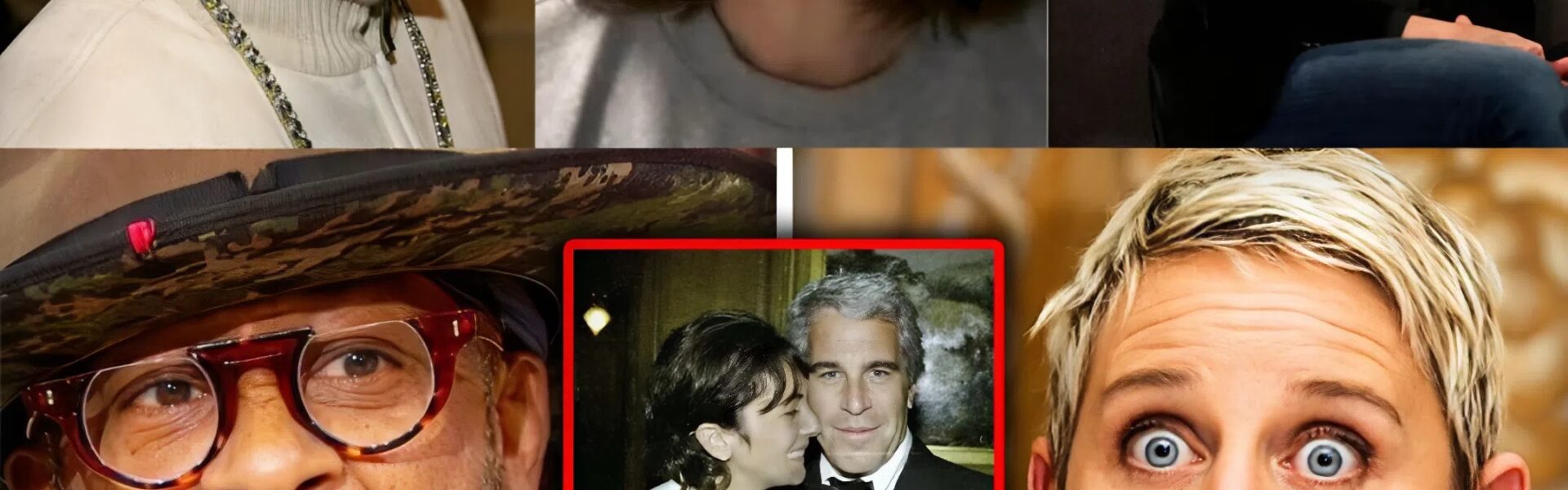
Katt Williams erupted at Ellen DeGeneres amid the Ghislaine Maxwell controversy — but one single remark about an “untouchable circle” left the entire room dead silent and sent social media into a frenzy.

The room did not go silent because Katt Williams raised his voice.
It went silent because, for once, everyone seemed to understand exactly what he was not saying.
At first, it looked like just another televised collision between celebrity, comedy, and the kind of controversy people pretend they are tired of while secretly waiting for the next clip to drop. The stage lights were soft, the chairs were arranged for friendly conversation, and the audience had been trained to laugh at the right pauses. But there was a pressure in the air that evening, a strange compression, as if the walls of the studio were holding back something heavier than applause.
Katt sat back in his chair with one hand resting over the other, his expression unreadable. Ellen DeGeneres sat across from him with the practiced calm of someone who had survived decades of headlines, backlash, reinvention, and public judgment. Between them was a low table with two glasses of water nobody had touched.
The segment had not been advertised as dangerous. It was supposed to be about comedy, career comebacks, Hollywood rumors, and the old machinery of fame. The producers had expected sharp lines, maybe a viral joke, maybe a playful jab at the industry. They had not expected the name Ghislaine Maxwell to enter the conversation like a cold draft under a locked door.
Yet that was how it began.
Not with a direct accusation. Not with shouting. Not with evidence waved in the air or a dramatic confession. It began with a question from the host, delivered with a smile that looked comfortable only from a distance.
“People say you’ve been calling out Hollywood for years,” Ellen said. “Do you ever worry that people misunderstand what you’re trying to say?”
Katt looked at her for a long moment before answering.
“People don’t misunderstand warnings,” he said. “They just decide whether the warning costs too much to hear.”
A few people in the audience laughed, unsure whether they had been invited to. The laugh died quickly. Ellen’s smile stayed in place, but it narrowed.
For years, Katt Williams had built a reputation that was hard to categorize and even harder to dismiss. To some, he was a comic who could turn pain into prophecy. To others, he was a man too honest for a room full of publicists. He had always seemed like someone standing halfway inside the entertainment industry and halfway outside of it, close enough to know the rules and far enough away to mock them without permission.
That made him dangerous in a very specific way.
He was not dangerous because he knew everything. Nobody knew everything. He was dangerous because he had spent decades watching who laughed together, who protected whom, who disappeared after saying the wrong thing, and who always seemed to land safely no matter how many scandals circled their name.
Ellen, by contrast, had mastered a different kind of survival. Her image had once been built on warmth, dancing, generosity, and a carefully polished kind of daytime friendliness. Then came the bruising years, the workplace stories, the public reassessment, the interviews that tried to soften what the internet had sharpened. She knew what it meant to be loved loudly and questioned even louder.
So when the Maxwell controversy surfaced in the conversation, the studio changed temperature.
It happened after Ellen mentioned, lightly, that not every association in Hollywood should be treated like a crime. It was the kind of sentence public figures used when they wanted to sound reasonable without stepping too close to the fire.
“People meet people at events,” she said. “People take pictures. People get put in rooms with people they barely know. The internet turns everything into a conspiracy.”
Katt leaned forward.
“The internet didn’t invent locked doors,” he said.
Nobody laughed that time.
A producer behind the camera shifted his weight. Someone in the control room lowered the volume of the audience mics, though no one later admitted ordering it. A floor manager glanced toward the exit as if trying to remember whether the doors were open or sealed.
Ellen tilted her head.
“That’s a heavy thing to say,” she replied.
“It’s a heavy thing to ignore,” Katt said.
The exchange lasted less than fifteen seconds, but by the time it was clipped, reposted, slowed down, captioned, translated, and argued over by millions of strangers, it would become the opening spark for a digital wildfire. People would freeze the frame on Ellen’s face. They would circle Katt’s hand movements. They would debate whether the audience had been silent because they were shocked or because something had been edited out.
But the real moment had not arrived yet.
The real moment came after Ellen tried to move the conversation away from names and toward abstractions. She smiled again, more carefully this time, and said, “I think the danger is that people want villains so badly, they forget how complicated life is.”
Katt nodded once.
“Complicated is what people call it when the rich need fog.”
That line got a reaction. A low murmur spread through the audience, not applause, not disapproval, but recognition. Everyone had heard versions of that idea before. Hollywood had always sold itself as a dream factory while asking the public not to look too long at the machinery underneath.
Ellen reached for her glass of water and finally took a sip.
“Are you saying you think powerful people protect each other?” she asked.
Katt smiled, but there was no warmth in it.
“I’m saying some circles don’t have entrances,” he said. “They only have gates.”
The audience went still.
Ellen blinked. The producer in the control room whispered something into a headset. The camera stayed on the two-shot too long, catching both faces in the same frame: Ellen trying to hold the mood together, Katt looking like a man who had just placed a key on a table and refused to say which door it opened.
Then Ellen asked the question that would replay endlessly online.
“And what circle are you talking about?”
Katt did not answer immediately. He looked past her, beyond the audience, toward the blackness behind the cameras. For a second, he seemed less like a performer and more like someone remembering a hallway, a party, a warning given too late.
Finally, he said, “The untouchable circle.”
The silence after that was total.
Not dramatic silence. Not edited silence. Real silence. The kind that makes people suddenly aware of their own breathing.
Ellen’s face changed by a fraction. It was almost nothing, but in the world of viral clips, almost nothing becomes everything. Her smile disappeared, returned, and then settled into something more formal.
Katt sat back again.
“And the thing about an untouchable circle,” he added softly, “is everybody outside it thinks it’s a rumor until somebody inside it stops answering calls.”
That was the clip.
Within an hour, it was everywhere.
By midnight, people who had not watched the full interview were arguing as if they had been sitting in the studio. Accounts with blue checkmarks posted theories. Anonymous pages posted edited montages. Commentators built entire narratives around four seconds of Ellen looking down. Comedy fans praised Katt for “saying what everyone else was afraid to say.” Skeptics accused the internet of turning vague language into a courtroom.
But the strangest part was not the outrage.
The strangest part was what disappeared.
The official upload of the interview was delayed. Then shortened. Then replaced with a version where the lighting looked slightly different and the pause after “untouchable circle” was trimmed by a second and a half. To most viewers, that would have meant nothing. To the internet, it was blood in the water.
“Why cut the silence?” one user posted.
“Because the silence was the answer,” someone replied.
By morning, the phrase had become a slogan, a suspicion, and a trap. The Untouchable Circle. People put it in hashtags, thumbnails, podcasts, and late-night monologues. Some used it seriously, some mockingly, some with a hunger that seemed less about truth and more about spectacle.
Katt said nothing for twenty-four hours.
That silence only made the noise louder.
Inside the studio’s parent network, the reaction was more controlled but no less tense. Conference calls began before sunrise. Public relations teams reviewed every second of the footage. Lawyers asked whether anything had been stated as fact. Producers insisted the edit was routine. Executives asked why nobody had anticipated the direction of the conversation.
One assistant, who had been in the greenroom that day, remembered something odd.
Before the interview began, Ellen had asked if the Maxwell question was still in the prep packet. A producer told her it had been removed. Katt, according to the assistant, had overheard enough to smile.
Not a big smile.
Just enough to suggest he knew when a door had been closed on purpose.
The assistant did not post about it publicly. She told one friend, who told another, and by the end of the week, an unnamed “production source” became part of the growing legend. That was how modern scandals fed themselves: not with proof, but with fragments that felt shaped like proof.
Meanwhile, Ellen’s team prepared a response.
It was clean, careful, and almost too polished. The statement said the conversation had been wide-ranging, that no allegations had been made against any individual on the program, and that Ellen believed in fairness, truth, and compassion for victims. It did not mention the phrase “untouchable circle.”
That omission became its own headline.
Katt finally responded two days later, not with a press release, but with a short video filmed in what looked like the back of a car. He wore dark glasses, though it was nighttime. City lights slid across the window behind him.
“I see everybody asking me what I meant,” he said. “I meant what made the room quiet.”
He paused, then leaned closer to the camera.
“And if you don’t know why the room got quiet, you ain’t been invited to enough rooms.”
The video ended there.
It was less than twenty seconds long. It did not clarify anything. It did what Katt Williams, at his most effective, had always done: it made people feel as if the truth was standing just offscreen, waiting for someone brave enough to turn the camera.
The internet turned the camera for him.
Old photographs were pulled from archives. Guest lists from charity events were circulated without context. Talk show appearances were resurfaced. Every celebrity who had ever been near the orbit of scandal, power, money, or private islands became a node in someone’s homemade map. Some maps were absurd. Some were reckless. Some were quietly frightening because they revealed how easily fame could blur proximity into suspicion.
But beneath the chaos, there was a real question people could not stop asking.
Why had the room gone silent?
It was not enough to say the audience was shocked by a dramatic phrase. Audiences loved dramatic phrases. They cheered them. They clipped them. They turned them into merchandise. This silence had felt different, as if a private rule had been broken in public.
A retired television producer named Marla Jennings explained it best on a small podcast that unexpectedly went viral.
“In studios, silence is rare,” she said. “Audiences are warmed up. They are encouraged to react. They laugh because they want to participate. When a room full of trained audience members goes completely still, it means they are no longer watching a performance. They think they may be witnessing a mistake.”
That sentence became the second wave.
A mistake.
People began asking whether Katt had gone off-script, whether Ellen had expected the topic, whether someone had warned the production team not to let certain names surface. Theories multiplied faster than denials could contain them.
Ellen remained silent for nearly a week.
For someone who had spent much of her career controlling tone through charm, the silence felt unnatural. Friends told entertainment reporters she was frustrated by how a vague exchange had been twisted. Others said she felt blindsided. One anonymous source insisted she had no idea Katt would take the conversation there.
But another source, closer to the production, claimed Ellen had been warned.
According to that version, Katt’s team had made it clear before the taping that he would not participate in a “softball nostalgia segment.” He wanted to talk about power. He wanted to talk about why certain celebrities were rehabilitated while others were exiled. He wanted to talk about the difference between cancel culture and containment.
Containment.
That word became important later.
Because three days after Katt’s car video, a longer clip leaked.
It was grainy, filmed from a monitor in what appeared to be an editing bay. It showed thirty-six seconds that had not appeared in the broadcast. The quality was poor, but the audio was clear enough.
In the leaked clip, Ellen asked, “Do you think everyone who stays quiet is guilty?”
Katt replied, “No. Some people are scared. Some people are paid. Some people signed something. And some people learned a long time ago that silence gets rewarded better than honesty.”
Ellen said, “That sounds like a very dark view of people.”
Katt answered, “No. That’s a very clear view of systems.”
Then came the part that changed everything again.
Ellen looked toward the side of the stage and said, “Can we reset?”
The clip ended.
Within minutes, social media was consumed by one question.
Why did she ask to reset?
In television, resetting was ordinary. A host could stumble over a line. A guest could ask to repeat a thought. A noise could interrupt the take. But online, ordinary explanations rarely survived contact with a hungry audience. The phrase “Can we reset?” became evidence to some, theater to others, and a mirror for everyone’s existing beliefs.
Katt did not confirm or deny the leaked clip.
He posted only one sentence: “They reset cameras, not truth.”
By then, major outlets had begun covering the frenzy, cautiously at first. They avoided repeating the wildest claims. They framed the story as a viral controversy, a debate about celebrity culture, and a collision between conspiracy thinking and public distrust. Still, every article had to include the phrase that started it all.
The Untouchable Circle.
The phrase had power because it was elastic. It could mean Hollywood elites. It could mean billionaires. It could mean political donors, fixers, media executives, private security consultants, crisis managers, lawyers, and publicists. It could mean everyone and no one. That was what made it dangerous.
A phrase that broad can illuminate a system.
It can also swallow facts whole.
Katt seemed to understand that tension. During a stand-up set in Atlanta the following weekend, he walked onstage to a standing ovation before saying a single word. The audience shouted questions. Some yelled Ellen’s name. Others yelled Maxwell’s. Katt let the noise rise, then lifted one finger.
“You came for names,” he said. “But names ain’t the lesson.”
The crowd quieted.
“The lesson is, stop being shocked that powerful people know each other,” he continued. “Be shocked that powerless people are the only ones who ever seem to pay full price.”
That line cut through the spectacle.
For a moment, the controversy became less about whether one celebrity had embarrassed another and more about the public’s exhausted suspicion that accountability had become a luxury product. People were tired of watching apologies become strategy, scandals become branding, and silence become a shield.
Ellen’s defenders argued that she had been unfairly dragged into a storm built on insinuation. They said Katt had not accused her of anything specific because there was nothing specific to accuse. They said the internet had taken a tense conversation and inflated it into a morality play.
They had a point.
Katt’s supporters countered that specificity was exactly what powerful systems demanded from those without access to protected records, private settlements, sealed communications, and invitation-only rooms. They said survivors, witnesses, and outsiders were often dismissed until documents appeared years too late.
They had a point too.
The truth, as usual, was less satisfying than either side wanted.
There was no smoking gun in Katt’s phrase. There was no courtroom revelation. There was no public proof that Ellen had protected anyone, no verified evidence that the exchange exposed a hidden network, no document that turned the viral silence into a legal fact.
But there was something else.
There was a moment when a comedian known for refusing polished narratives sat across from a host known for mastering them, and the machinery of pleasant television briefly failed.
That failure fascinated people.
It fascinated them because everyone knows the feeling of watching a room pretend not to hear what was just said. Families do it. Companies do it. Churches do it. Studios do it. Governments do it. The performance of normalcy continues until someone says the sentence that makes pretending impossible.
“The untouchable circle” was that kind of sentence.
Not because it proved anything.
Because it named a fear people already had.
A week after the interview, a young journalist named Caleb Price began digging into the production timeline. Caleb worked for an online culture magazine that usually covered streaming wars and celebrity documentaries, but he had a reputation for being stubborn in the places other writers were theatrical. He did not want theories. He wanted process.
Who booked Katt?
Who approved the questions?
Who edited the final cut?
Why was the official upload delayed?
Most people refused to talk. A few spoke off the record. The picture that emerged was not explosive in the way the internet wanted, but it was revealing in a quieter sense.
The production team had expected friction. Katt had been unpredictable in pre-interviews. Ellen had wanted to address controversy broadly but avoid turning the segment into an interrogation about Maxwell, Hollywood, or elite protection networks. Standards and legal had flagged several topics as “high-risk.” The plan was to keep the conversation about public perception.
But live conversations do not always respect plans.
Caleb learned that during rehearsal, an executive had joked, “Just don’t let him say anything that gets us sued.” People laughed. Later, after the taping, nobody found the joke funny.
The delay in the upload, according to one editor, happened because multiple teams reviewed the segment. Legal wanted certain pauses tightened. Publicity wanted the tone softened. Digital wanted the clip fast because they knew it would trend. The final version was not censored, exactly, but shaped.
That word mattered too.
Shaped.
Public reality is often shaped long before the public sees it. Not always maliciously. Sometimes for time, clarity, pacing, legal caution, commercial interest, or simple fear. But shaping creates gaps, and gaps create suspicion.
When Caleb published his piece, it did not satisfy anyone completely. The conspiracy pages said he had ignored the real story. Ellen’s defenders said he had given oxygen to baseless innuendo. Katt’s fans said he had confirmed what they already knew: the room had been managed.
Katt posted the article with two words: “Good start.”
That made Caleb uneasy.
Because Caleb did not want to become part of Katt’s mythology. He did not want to be a character in someone else’s war against Hollywood. Yet as the days passed, he found himself returning to one detail none of his sources could explain.
After the taping ended, Katt had reportedly stayed seated.
The audience filed out. Ellen left the stage. Producers huddled near the monitors. But Katt remained in the chair for almost three minutes, saying nothing, looking at the empty seat across from him.
A stagehand asked if he needed anything.
Katt said, “No. I just wanted to see who came back.”
“Who did?” Caleb asked when the stagehand told him the story.
The stagehand hesitated.
“Only one person,” he said.
“Who?”
The stagehand would not say.
That missing answer became Caleb’s private obsession.
He did not publish it. It was too thin, too strange, too easy to sensationalize. But he wrote it in his notebook and circled it twice. Only one person came back. In a story already overrun with speculation, this was exactly the kind of fragment he should have ignored.
Instead, he kept thinking about it.
Two nights later, Caleb received an email from an address he did not recognize. The subject line read: “You asked the wrong question.”
The body contained only one sentence.
“It wasn’t who came back; it was what she was carrying.”
There was no signature.
Attached was a still image from the studio, time-stamped seven minutes after the taping ended. The picture showed the empty stage from a high angle. Katt was still seated. A woman in a dark blazer stood near the edge of the set, partly turned away from the camera. In her left hand was a folder.
Caleb zoomed in until the image broke into pixels.
The folder had no visible label.
He stared at it anyway.
By morning, he had convinced himself not to chase it. The story had already become a magnet for people who wanted hidden files, secret lists, and villains arranged in neat rows. A folder in a blurry image did not mean anything. In production, folders were everywhere: scripts, releases, notes, schedules, legal clearances.
Then a second email arrived.
This one had no text. Only another attachment.
A call sheet.
Not the public version. An internal one. Most of it was routine: arrival times, makeup, security, segment blocks, sponsor notes. But near the bottom, under a section labeled “Sensitivity Review,” one line had been highlighted.
“Do not allow guest to introduce protected names in relation to Maxwell matter.”
Protected names.
Caleb felt the ground shift beneath the phrase.
He knew what a cautious lawyer might mean by it: names that could create legal exposure if discussed without evidence. That was normal. But he also knew how it would look if released into the bloodstream of the internet.
Protected names sounded like confirmation.
It sounded like the untouchable circle had paperwork.
Caleb did not publish immediately. He called the network for comment. He called two entertainment attorneys. He called a former standards executive. All three told him the same basic thing: the phrase was clumsy but not sinister. In high-risk segments, teams often identified names that should not be raised casually because the legal consequences could be serious.
One attorney said, “Protected means protected from defamation risk, not protected from accountability.”
That was clear.
It was also not enough to erase the feeling in Caleb’s stomach.
When he finally wrote the follow-up, he included the explanation. He quoted experts. He warned readers not to overinterpret internal production language. He did everything a responsible journalist was supposed to do.
The headline still exploded.
By afternoon, “protected names” was trending above everything else.
Katt did not post for several hours. When he finally did, it was not a joke, not a video, not a cryptic line. It was a paragraph.
“Every industry has words that mean one thing in the office and another thing to the people outside the gate. Protected. Managed. Contained. Reviewed. Cleared. The public hears those words and knows exactly why trust is gone.”
For once, even some of his critics paused.
Because he was right about trust.
The public did not trust the rooms anymore. Not the greenrooms, boardrooms, courtrooms, writers’ rooms, donor rooms, or private rooms where powerful people smiled for photographs and later claimed they barely knew each other. The Maxwell controversy had not created that distrust. It had exposed how deep it already ran.
Ellen’s team understood the danger now.
The story was no longer only about her. It had become a symbol, and symbols are harder to sue, harder to deny, and harder to retire. If she ignored it, the silence would be treated as fear. If she responded angrily, the anger would be treated as guilt. If she responded gently, the gentleness would be treated as performance.
So she chose the only option left.
She recorded a conversation.
No studio audience. No band. No dancing. No bright daytime set. Just Ellen in a chair, a plain background, and a camera close enough to catch every pause. She did not mention Katt in the opening minute. She talked about how quickly the internet turns people into symbols and how difficult it is to speak in a climate where every sentence is treated like evidence.
Then she said the line everyone clipped.
“I have not protected Ghislaine Maxwell or anyone involved in what she represents.”
It was the most direct sentence she had offered.
For some viewers, it helped. For others, it came too late. Katt’s supporters asked why she had not said it immediately. Skeptics asked why she needed to say it at all. Her defenders said the demand for denial proved how reckless the entire controversy had become.
But the conversation shifted again when Ellen continued.
“I do know what it feels like to be in rooms where people avoid names because names carry consequences,” she said. “Sometimes that caution is responsible. Sometimes it becomes cowardice. I have been responsible in my life, and I have been cowardly too.”
That admission changed the tone.
Not because it satisfied the internet. Nothing satisfied the internet. But because it sounded less like a statement drafted to end a scandal and more like a person acknowledging the moral gray zone celebrities often hide behind.
Katt watched the video, according to someone close to him, alone.
He did not laugh. He did not celebrate. He did not call it a victory.
He simply said, “Now we getting somewhere.”
The next chapter should have ended there.
It did not.
Because the woman in the dark blazer, the one from the blurry still image, finally became identifiable.
Her name was Dana Vale. She was not famous. She had spent twenty-two years moving through the entertainment industry in the spaces between public faces: talent coordination, crisis scheduling, reputation events, donor dinners, private screenings, emergency booking, cancellation management. People like Dana did not appear in headlines. They made sure other people survived them.
She had been on set the day of the interview.
She had also worked, years earlier, for a private event firm that handled guest logistics for wealthy clients whose names often overlapped with political, philanthropic, and entertainment circles. That alone proved nothing. But the internet did not need proof to become interested.
Caleb tried to contact Dana.
No response.
Then, on a rainy Thursday evening, she called him from a blocked number.
“You’re not going to understand this story if you keep chasing celebrities,” she said.
Caleb sat up in his chair.
“What should I chase?”
“Calendars,” Dana said.
The line went dead.
Calendars.
It was absurd. It was also precise enough to feel like instruction.
Caleb spent the next week examining public schedules, charity event dates, televised appearances, gala photographs, court timeline references, and the strange rhythm of public visibility. He was not looking for a grand conspiracy. He was looking for patterns of avoidance.
What he found was subtler and, in some ways, more disturbing.
Whenever certain scandals resurfaced, certain people vanished from casual public conversation. Bookings shifted. Questions narrowed. Panels changed topics. Old friendships became “brief encounters.” Longtime allies became “people I met once.” The machinery did not need a central command. It operated through instinct.
Protection, Caleb realized, did not always look like someone hiding a file.
Sometimes it looked like a producer choosing not to ask the next question.
Sometimes it looked like a host laughing one second too early.
Sometimes it looked like a publicist saying, “We’re not going there.”
Sometimes it looked like everybody in a room understanding the boundary at the same time.
That was the system Katt had been pointing toward.
Not a cartoon circle of villains meeting under a chandelier. Not a secret society with robes and passwords. Something more ordinary, more durable, and harder to prosecute: mutual preservation among people who knew the cost of exposure.
When Caleb published his final piece, he avoided the phrase “untouchable circle” in the headline. His editor fought him on it. The phrase guaranteed traffic. Caleb refused.
The headline read: “What Celebrity Silence Is Really Protecting.”
It performed well anyway.
The piece argued that the viral clash between Katt and Ellen mattered not because it proved a hidden allegation, but because it revealed a public craving for moral clarity in an industry built on controlled ambiguity. It examined the difference between evidence and suspicion, between legal caution and cultural cowardice, between protecting the innocent from reckless claims and protecting the powerful from uncomfortable questions.
The final paragraph was the one everyone quoted.
“A room does not have to contain a secret to reveal one. Sometimes the secret is simply the rule everyone follows without being told.”
Katt posted it without comment.
Ellen did not post it at all.
Dana Vale disappeared from the story almost as quickly as she had entered it. No interview, no memoir announcement, no dramatic thread. Just a woman who had spent years near the machinery and offered one word before stepping back into the shadow of it.
Calendars.
By then, the original clip had taken on a life beyond the people in it. It was used in video essays about power. It appeared in lectures about media distrust. It became a meme, then a reference, then a shorthand. Months later, people who had never seen the interview still understood what someone meant when they commented, “That room got untouchable-circle quiet.”
Katt returned to touring.
Ellen retreated again from the loudest parts of public life.
The internet moved on, as it always does, but not completely. Certain stories leave residue. They settle into the public imagination because they give language to something people had been feeling without a phrase.
The untouchable circle was one of those phrases.
It lived because it was not only about Hollywood.
It was about every workplace where the boss’s friend never faced consequences. Every family where the truth was considered ruder than the harm. Every institution where the person asking the question became the problem. Every room where silence was treated as maturity and honesty as disruption.
That was why the clip endured.
Not because