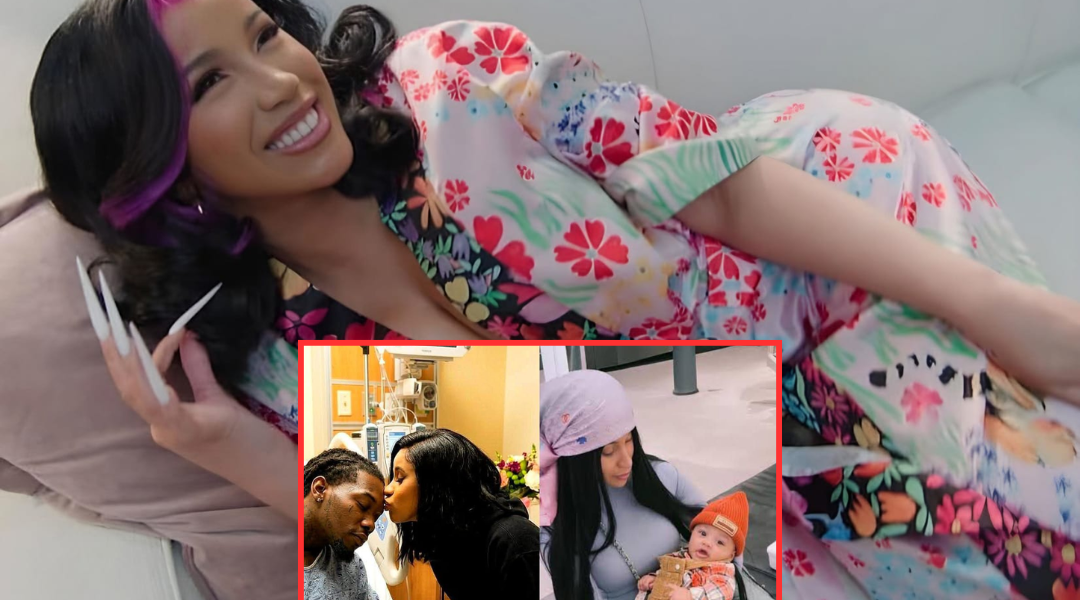
BREAKING NEWS: Offset is reportedly demanding a DNA test for Cardi B’s baby amid speculation involving Stefon Diggs — and a new mystery surrounding the baby has now emerged.

The rumor did not begin with a statement, a court filing, or a confirmed interview. It began the way so many modern storms begin: with a sentence passed from one screen to another, sharpened by repetition, softened by denial, then sharpened again by speculation until it no longer resembled the thing it might once have been.
By noon, people were no longer asking whether Offset had actually demanded a DNA test for Cardi B’s baby. They were speaking as if the demand itself were already part of an unfolding reality, and the only remaining question was why it had happened, who had pushed it into the light, and what hidden tension had existed long before the public ever sensed it.
At first, the rumor seemed almost too blunt to survive.
A private family matter, placed beside the names of people whose lives had already spent years under cameras, was exactly the kind of combustible narrative the internet knew how to feed. Nothing had to be proven for the story to travel. It only had to suggest betrayal, uncertainty, wounded pride, and one more secret still waiting behind the curtain.
That final ingredient was what made the rumor metastasize.
Not merely the alleged demand for a DNA test, not merely the sudden attachment of Stefon Diggs’s name to the swirl of commentary, but the arrival of another phrase, more slippery and more dangerous than the rest: a new mystery surrounding the baby.
Nobody seemed able to define that mystery with precision.
And because nobody could define it, everyone could expand it. Some framed it as a question of timing. Some treated it as a question of appearances, hidden conversations, old timelines revisited with obsessive confidence by strangers who had never been in the room for any of it.
Others, inevitably, made it emotional.
They said the real mystery was not biological at all, but relational. Why had people around the situation gone quiet at the same moment the gossip grew louder? Why did certain posts disappear? Why were fans suddenly reading significance into silence, into body language, into old photographs, into who stood beside whom at afterparties, tour stops, and private exits through side doors?
By evening, the story had become less about evidence than atmosphere.
The names involved were enough to create a pressure field around any rumor, and in that pressure field even ordinary details took on a theatrical weight. A delay in responding looked strategic. A smile in an unrelated clip looked forced. A refusal to comment began to sound, to some people, like an invitation to imagine the worst.
But beneath all of that noise there remained a human core.
Strip away the reposts, the thumbnails, the sensational captions, and what remained was a fragile possibility: that two people with a history too public to protect were once again being watched at the moment their private fractures might have become impossible to hide.
Cardi B had lived for years in that uncomfortable borderland between performance and confession.
She knew how to turn chaos into language, pain into rhythm, humiliation into spectacle and then back into power. The public had come to expect from her not just visibility, but a kind of emotional candor that felt immediate even when it was carefully controlled.
That expectation was both her strength and her burden.
Because once an audience believes it knows how you sound when you are angry, hurt, amused, or exhausted, it also begins to believe it can detect those feelings even when you say nothing at all. Silence becomes readable. Distance becomes narrative. Delay becomes motive.
Offset, by contrast, moved through rumor differently.
Even when he said little, his presence carried implication. People projected onto him ideas of pride, jealousy, territorial instinct, and old unresolved wounds. Whether fair or unfair, his silence often seemed to deepen speculation instead of diffusing it.
The history between them made that inevitable.
This was not a story about strangers suddenly linked by gossip. It was a story built atop years of reconciliation, fracture, public loyalty, private hurt, visible chemistry, emotional reversals, and the kind of repeated return that taught observers to believe the end was never entirely the end.
Because of that history, the rumor of a DNA test landed as more than a headline.
It landed like a symbolic escalation, a gesture so intimate and so accusatory that it seemed to imply something had ruptured at a level deeper than ordinary celebrity conflict. People did not hear laboratory procedure. They heard distrust made official.
And distrust, once spoken aloud, changes the temperature of every room around it.
Friends begin to choose words more carefully. Relatives become sources by accident. Team members, stylists, assistants, security personnel, and people who are supposed to know how to keep their faces neutral suddenly become part of the public imagination.
The public does not need access to the room.
It only needs to believe the room exists, and that something inside it is trembling. Once that belief takes hold, every fragment becomes meaningful. Every omission becomes evidence. Every unrelated event can be pulled back into the orbit of the main story and made to serve it.
So when Stefon Diggs’s name was dragged into the narrative, the effect was immediate.
He was not merely another celebrity name added for reach. He represented, in the architecture of rumor, a possible line crossing. His presence made the story feel sharper, more triangulated, more perilous.
That was enough for the internet to begin constructing scenes it had never witnessed.
People imagined late-night confrontations. They imagined private calls, messages left unread, arguments paused when children entered the room, doors closing harder than usual, handlers standing nearby and pretending not to hear. None of this required proof. It only required an audience trained to complete dramatic patterns.
Yet the most unsettling part of the story was not the aggression of the gossip.
It was the way the baby became both center and shadow. Everyone claimed to be talking about the child, but most of what they really discussed were the adults—their pride, their anger, their timelines, their possible betrayals. The child existed in the discourse as an emblem, not a person.
That distortion happens often in highly public family narratives.
Children become symbols through which adults fight old wars. They become proof, leverage, innocence, vulnerability, continuity, and consequence all at once. Their existence clarifies nothing for the public, but intensifies everything.
And then there was that phrase again.
A new mystery surrounding the baby. It floated above the entire discussion like fog over water, thick enough to obscure, thin enough to invite movement. People were drawn toward it precisely because it had no fixed shape.
Some said the mystery involved timing and paternity.
Others insisted that was too obvious, that the real mystery had to do with something else entirely—a detail someone close to the family supposedly noticed, or a question that had been raised quietly and then sealed off before it could become public.
Still others claimed there was no mystery at all.
They argued that the phrase had been invented because rumor is never satisfied with a single point of drama. It needs escalation. Once the alleged DNA test became familiar, the narrative required a second chamber, another locked door, one more suggestion that the visible story was only the outer shell of something stranger.
But if the mystery was invented, it was invented brilliantly.
Because nothing compels people like the suggestion that the official version of events is incomplete. Human curiosity is rarely strongest when something is explained. It is strongest in the gap between explanation and suspicion, where the mind begins to write its own connective tissue.
The people closest to high-profile lives understand this better than anyone.
They know that information no longer travels in straight lines. It leaks sideways, mutates in transit, fuses with older grievances, and returns carrying details no original speaker ever supplied. By the time someone tries to correct it, the correction feels weaker than the speculation it follows.
Inside that ecosystem, truth loses the advantage of being true.
Truth is often slow, fragmented, inconvenient, unpolished. Rumor is fast. Rumor arrives with music already playing behind it. Rumor gives audiences the emotional shape of a story before the facts have had a chance to stand up.
This is why the alleged demand mattered whether or not it could be verified.
Its existence in public language already altered the emotional geometry around the people involved. It made every future move interpretable through distrust. It made kindness look strategic, anger look confirming, and restraint look ominous.
There were fans who refused the story immediately.
They saw it as yet another attempt to turn a complicated family into a consumable crisis. They pointed to the absence of direct confirmation and treated the rumor as a predatory amplification of private tension for public entertainment.
There were others who did not exactly believe it, but wanted it to be true.
Not because they wished harm on anyone, but because a story that dramatic promised emotional resolution. If a DNA test were demanded, then there had to be a reason. If there was a reason, then eventually there might be a confrontation. If there was a confrontation, then at last there might be answers.
Answers are what audiences pretend to want.
But often what they actually want is a better mystery, one that feels closer to resolution while preserving the pleasure of suspense. A fully explained story ends too quickly. A story that almost explains itself can last for days, weeks, sometimes months.
That is where this rumor seemed designed to live.
In the almost. In the pause before denial, the pause before confirmation, the pause before a trusted source or a careful post or a dismissive livestream comment might redirect the entire thing. Until then, people remained suspended inside possibility.
Somewhere within that suspended space was a more difficult question.
What happens to trust when private doubt becomes public language? Even if a demand is never formally made, the rumor that it might have been can still wound. It tells the world that certainty no longer exists where intimacy should have protected it.
That kind of wound is hard to manage under ordinary conditions.
Under celebrity conditions, it becomes nearly impossible. Every emotional response is weighed for sincerity. Every act of composure risks being labeled cold. Every display of pain risks becoming content for strangers who think empathy means access.
Cardi B, more than most, understood the cost of access.
Her connection to her audience had always been built partly on openness, but openness is not the same thing as unlimited entry. There are parts of a life that remain unshareable even for people who have made careers from speaking plainly.
And yet fame punishes those boundaries.
The moment a public figure says, This part is private, that part becomes newly desirable. Silence creates value. Restraint creates demand. The closed door becomes more fascinating than the open one ever was.
So the story kept growing.
An old clip would resurface and be interpreted as foreshadowing. A concert appearance would be combed for emotional clues. A social media post that might have meant anything in anot