News

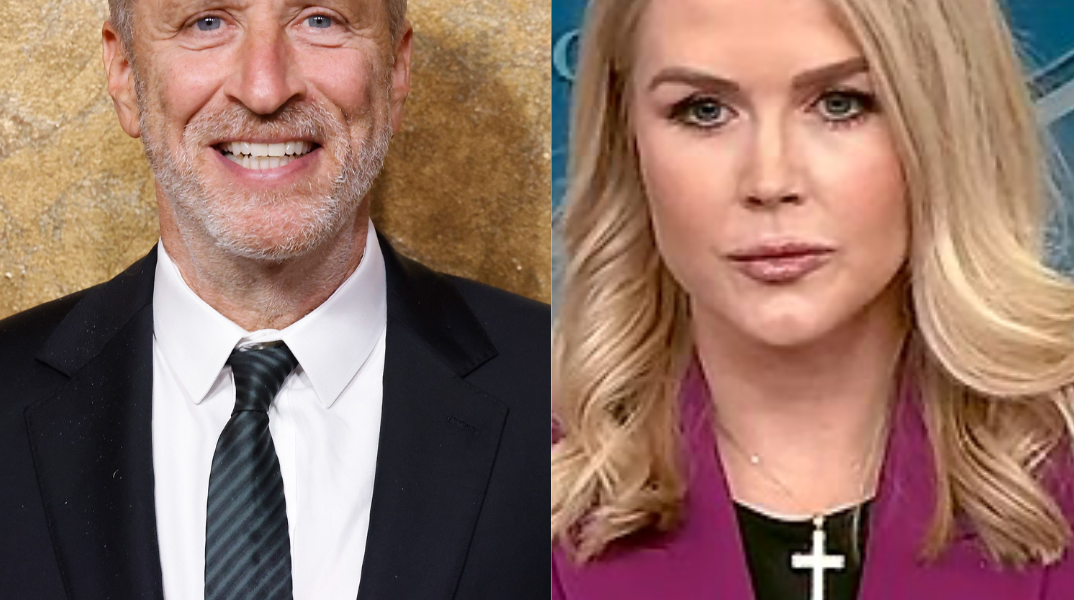
She went head-to-head with Jon Stewart, but he calmly let her set her own trap before landing a perfectly timed punchline that sent her into an on-air tailspin. Flustered and scrambling, she couldn’t recover — and Stewart’s silence did the rest. Now hailed as one of the year’s most brutal live TV moments. Full story in comments.

What was supposed to be a lively exchange of ideas between Jon Stewart and his guest quickly turned into one of the most dissected and replayed moments in recent television history. The segment began innocently enough, with Stewart introducing his guest — a sharp-tongued pundit known for her fast talking and confident delivery — and inviting her to share her views on a hot-button political issue.

From the start, she came in swinging. With rapid-fire talking points and a tone dripping with certainty, she attempted to steer the conversation into territory she clearly felt she could dominate. Her strategy seemed straightforward: overwhelm Stewart with polished rhetoric, challenge his points before he could finish them, and assert herself as the sharper intellect in the room.

But Stewart didn’t take the bait. Instead of interrupting or debating her point-for-point, he leaned back, nodding occasionally, letting her speak uninterrupted. At first glance, it might have looked like he was conceding ground. In reality, he was patiently letting her build the very trap she was walking into.

As she went on, her statements began to contradict each other. Stewart, still calm and measured, gently asked for clarification on one particular point. She answered quickly, perhaps too quickly, in a way that further tangled her earlier claims. The audience chuckled lightly, sensing the shift, but Stewart kept his composure, his expression unreadable.

Then came the moment. After allowing her to dig deep enough into her own contradictions, Stewart leaned in slightly, and with perfect timing, delivered a single, razor-sharp punchline. It wasn’t loud, it wasn’t aggressive — but it was so precise that the audience erupted in laughter and applause.

The impact on his guest was immediate. Her confident posture faltered, her voice wavered, and she began to stammer as she tried to backtrack. The more she struggled to recover, the more the audience leaned into the moment. Stewart didn’t push further; he didn’t need to. He simply sat back, a small smile on his face, and let the silence do the rest of the damage.

It was the kind of silence that speaks louder than words — a pause that underscored the fact that her argument had completely unraveled. Every second of that quiet felt heavier than the last, and the cameras caught it all: her discomfort, the flicker of realization that she had lost control of the conversation, and Stewart’s calm, almost surgical dismantling of her position.

By the time the segment ended, the balance of power in the room had completely shifted. What began as her attempt to intellectually spar with one of television’s sharpest minds ended with a public unraveling that viewers wouldn’t soon forget.

Clips of the exchange hit social media within minutes. On Twitter, TikTok, and Instagram, the punchline-and-silence combination was shared millions of times. Memes, reaction videos, and slow-motion breakdowns flooded timelines, each one framing Stewart’s tactic as a masterclass in debate. Hashtags like #StewartTakedown and #SilenceWins trended for days.

Political commentators and media analysts weighed in, many praising Stewart’s ability to dismantle an argument without raising his voice or losing his cool. They pointed out that his victory wasn’t in the punchline alone, but in his restraint — letting the moment breathe, allowing the silence to magnify the impact.

For Stewart’s guest, the fallout was swift and brutal. While her supporters insisted she had been “set up” and that the clip was being taken out of context, the viral moment became an inescapable reference point in every subsequent interview and online discussion about her. It was, as one columnist put it, “a single exchange that may follow her for the rest of her career.”

As for Stewart, it was another reminder of why he’s considered one of the most formidable figures in political satire and debate. With one perfectly timed joke and the discipline to let it breathe, he turned an ordinary interview into an unforgettable television moment — one that will be studied, replayed, and talked about for years to come.


LEAVE A RESPONSE

Email của bạn sẽ không được hiển thị công khai. Các trường bắt buộc được đánh dấu *

News

Karoline Leavitt Tried to Corner De Niro on Live TV — But One Sentence from Him Changed Everything Karoline Leavitt stepped into the studio with a plan. Dressed in crisp professionalism and armed with talking points designed to provoke, she believed she had the upper hand. The cameras rolled, the lights glared, and millions of viewers tuned in — but what unfolded in the next few minutes would not be the victory she expected. Instead, it became a moment that left the studio in stunned silence, the internet ablaze, and the nation asking a single question: What did Robert De Niro say — and how did one sentence silence one of the boldest conservative voices on live television? A Tense Setup from the Start The segment was billed as a “no-holds-barred discussion” between two opposing worlds — a conservative political firebrand and one of Hollywood’s most outspoken liberal legends. Leavitt, a former Trump spokesperson and now a rising right-wing media figure, had been outspoken in her criticism of De Niro’s political activism for years. But this was the first time the two had ever met face-to-face — and it was live, unscripted, and uncensored. Even before the interview began, tension hung in the air. Viewers noted how Leavitt’s tone in the introduction was laced with sarcasm, referring to De Niro as “the actor who thinks he’s a politician.” De Niro, stoic and tight-lipped, gave nothing away. Few knew what was about to happen. The Exchange Begins Leavitt opened with what many expected: jabs about Hollywood, accusations of hypocrisy, and thinly veiled references to De Niro’s past controversies. “You’ve spent decades playing tough guys on screen,” she said with a smile that didn’t reach her eyes. “But do you ever worry that in real life, you’re just another elitist lecturing the rest of us?” The audience chuckled nervously. De Niro didn’t respond. He waited. Leavitt pressed on: “You’ve made statements calling certain political figures ‘criminals,’ ‘thugs,’ even ‘a danger to democracy.’ Don’t you think that kind of rhetoric is dangerous?” Still calm, De Niro simply replied: “I think silence in the face of corruption is far more dangerous.” It was sharp, but not the moment that changed everything. That came just seconds later. The Line That Left Everyone Speechless Leavitt leaned in. “So you see yourself as some kind of moral authority?” she challenged. And that’s when De Niro finally looked her directly in the eyes, leaned back in his chair, and said: “No — but at least I’m not pretending to be something I’ve never earned.” The words landed with an audible thud. The audience stopped breathing. Even the host, who had tried to remain neutral, blinked in disbelief. Leavitt froze. Her expression faltered, just for a moment — enough for the viewers at home to catch it. And just like that, the dynamic in the room shifted completely. Why That One Sentence Hit So Hard It wasn’t just the delivery. It wasn’t just the timing. It was the implication behind De Niro’s words — and the weight of his decades in the public eye. Many interpreted the line as a subtle jab at Leavitt’s rapid political ascent, her close ties to controversial figures, and her tendency to position herself as a patriotic underdog without the record to back it up. In contrast, De Niro — for all his polarizing moments — has decades of awards, activism, and cultural influence behind him. Whether you love him or loathe him, his voice carries weight. And that weight was felt like a punch across the airwaves. Social Media Reaction: “She Walked Right Into It” Within minutes, clips of the exchange flooded Twitter, TikTok, and YouTube. The moment was replayed, remixed, and captioned across platforms. “That was brutal. She walked right into it.” “You don’t go toe-to-toe with De Niro unless you’re ready for blood.” “He said that with ice in his veins.” Even those who typically disagreed with De Niro politically admitted it was a devastating line — and that Leavitt had underestimated her opponent. A Cultural Clash: More Than Just a Debate What made this moment so explosive wasn’t just the personal sting. It was the symbolism. Here was a Gen Z conservative firebrand, media-savvy and bold, confronting a Baby Boomer icon whose worldview was shaped by Watergate, Vietnam, and decades in the cultural spotlight. Two Americas. Two definitions of patriotism. Two completely different standards of truth. Leavitt brought confrontation. De Niro brought history. And in that single moment — just one sentence — the generational, political, and cultural clash reached its boiling point. Damage Control Begins Leavitt’s team responded quickly after the segment, releasing a statement claiming De Niro had “attacked her character without cause” and calling the show “a setup designed to humiliate.” They pointed out that De Niro was given advance warning of the topics, while Leavitt allegedly wasn’t. But fact-checkers quickly noted: both parties had been briefed. Meanwhile, De Niro remained silent. No follow-up statement. No interviews. Just one post on his official account: “When the truth is uncomfortable, people call it an attack. I call it honesty.” Once again, minimal words — maximum impact. Media Divided — But Viewership Soars As expected, media outlets quickly took sides. Left-leaning pundits hailed De Niro as a symbol of “grace under pressure,” praising his restraint and sharp wit. Right-leaning outlets accused the show of ambushing Leavitt, painting De Niro’s comment as “smug and elitist.” But if there was one thing everyone agreed on — it was that this moment would be replayed for years. Ratings for the show skyrocketed. Analysts said it was one of the most-watched live interviews in months, if not years. Why This Moment Matters Now In a country deeply divided by ideology, generational shifts, and media echo chambers, this encounter struck a nerve. It wasn’t just about De Niro vs. Leavitt. It was about who gets to define truth. Who gets to speak with authority. Who gets to represent “the people.” And what happens when performance meets authenticity — live, unfiltered, and unprepared. Where Do They Go From Here? For Karoline Leavitt: Sources say she’s doubling down — preparing a follow-up appearance to “clarify her side.” Insiders claim she’s planning to reframe the narrative, highlighting what she calls “Hollywood’s obsession with silencing dissent.” She’s also reportedly been invited to appear on several right-wing platforms to “set the record straight.” For Robert De Niro: He’s saying little — letting the moment speak for itself. But insiders say he’s “completely unfazed” by the controversy and views it as proof that “telling the truth, even once, can cause an avalanche.” Final Thoughts: When One Sentence Becomes a Turning Point Live television has always been unpredictable. But every now and then, a single moment transcends the screen. A few words, delivered without theatrics, can shift the power dynamic and reveal something deeper — about our culture, our values, and ourselves. Robert De Niro didn’t come to fight. He didn’t shout. He didn’t insult. He just waited… and when the moment came, he used his silence like a scalpel — cutting straight through the noise with one cold, calculated truth. And in doing so, he reminded the world why experience still matters — and why, sometimes, the loudest mic drop is the one whispered with conviction. What’s next? Will Karoline Leavitt bounce back — or has this viral moment changed the public’s perception for good? One thing’s clear: the world was watching… and no one will forget what happened that night.